
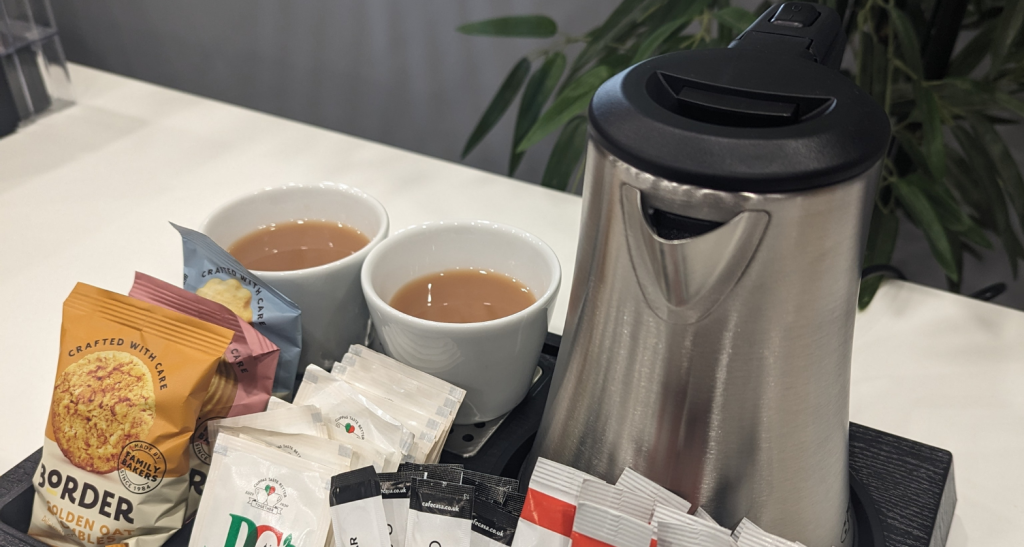
For many hotel guests, making a cup of tea or coffee in their room is a familiar part of the stay. It offers convenience after a long journey, a welcome start to the morning or a quiet moment before heading out.
For hotel operators, however, providing complimentary tea and coffee involves more than simply placing a kettle and a few sachets in each room. Product selection, presentation, replenishment and cost all influence whether the provision delivers value for both the guest and the business.
So, in 2026, what should hotels consider when reviewing their in-room tea and coffee offering?
Guests increasingly expect their accommodation to deliver a convenient, comfortable and consistent experience. While location, cleanliness and price remain important, smaller details can also influence how a stay is perceived.
Research from HOSPA and Amadeus in 2026 highlights the importance of guest experience, convenience and consistency across the hotel journey. Their findings reinforce a practical point for operators: the basics still matter, and small frustrations can affect an otherwise positive stay.
An accessible tea and coffee station gives guests the option to enjoy a hot drink on their own terms, without having to contact reception or visit a restaurant. It can be particularly useful for early risers, guests arriving late and those who prefer to relax in their room.
The value lies not necessarily in providing an extensive selection, but in making sure the essentials are available, easy to use and suitable for the type of accommodation.
Providing complimentary refreshments is one thing; providing refreshments guests actually want is another.
A basic selection may be appropriate for some properties, while others may benefit from a broader choice of coffee, speciality teas, hot chocolate or alternative milk options. The right approach depends on the hotel’s positioning, guest profile, room rate and wider service offering.
Research commissioned by Nestlé Professional and conducted by 3Gem in 2025 found that coffee quality influenced overall hotel ratings for a substantial proportion of surveyed coffee-drinking guests, particularly those staying in four- and five-star properties. The findings suggest that beverage quality deserves consideration as part of the overall guest experience, rather than being treated as an afterthought.
Explore the Coffee in UK Hotels 2025 research for further insight. As this research was commissioned by a coffee supplier, its findings should be considered in that context.
For hotel operators, a useful starting point is to review guest feedback and assess whether the current selection reflects expectations. Are guests asking for better coffee? Are popular items frequently running out? Is the range unnecessarily complicated for housekeeping teams to manage?
Reviewing these questions can help hotels make informed adjustments instead of spending more without a clear purpose.

Tea, coffee, milk, sugar and biscuits may be complimentary to guests, but they still represent an ongoing operating cost.
The challenge is to balance a positive guest experience with sensible purchasing, stock management and replenishment. A low-cost selection that disappoints guests may offer limited value, while an unnecessarily elaborate range can introduce additional expense and complexity.
Hotels should consider the full cost of providing refreshments, including:
Standardising the core selection across rooms can make purchasing and replenishment more straightforward. Additional options can then be introduced where they support a clear guest-experience objective, such as a premium room category or a particular guest requirement.
For a practical starting point, explore the range of hotel tea, coffee and milk supplies.
A hospitality tray is more than somewhere to store tea bags and coffee sachets. It helps organise the refreshments, keeps the area looking presentable and gives guests a clear place to prepare a drink.
The choice of tray should reflect the room layout, available space, equipment and overall style of the property. A compact solution may suit a smaller room, while a larger or more premium setup may work better where guests have more space and higher expectations.
Explore the range of hotel hospitality tea and coffee trays to compare options for different room settings.
Coffee machines can also be worth considering where they suit the property’s positioning and budget. Before introducing pod machines or other upgraded equipment, operators should assess purchase costs, capsule supply, cleaning requirements, staff procedures and how easily the equipment can be used by guests.
The aim is not to make every room more elaborate. It is to provide an arrangement that feels considered, works reliably and is straightforward to maintain.
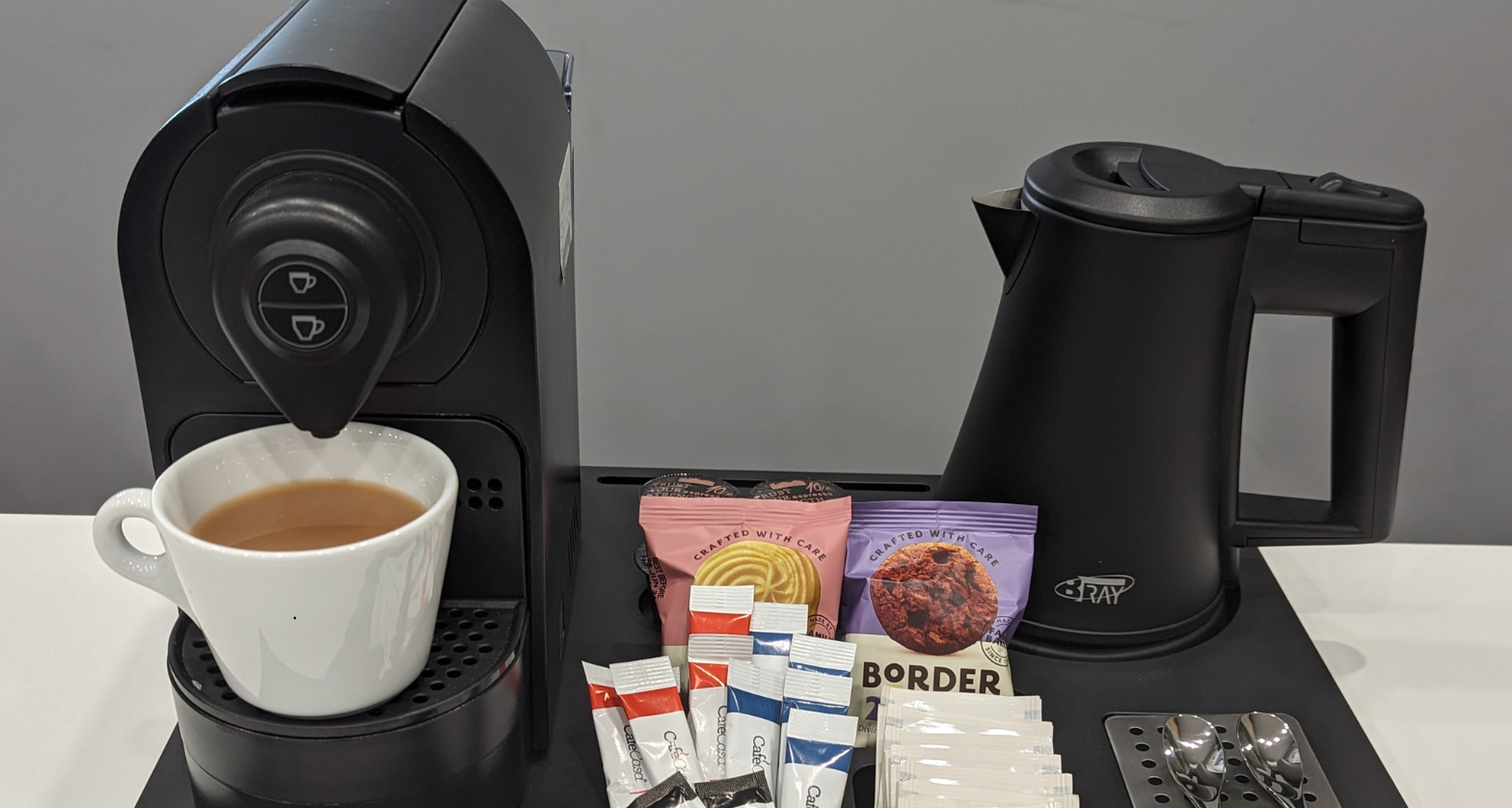
Even a well-chosen hospitality tray can disappoint if it is poorly maintained. Empty supplies, sticky surfaces, used sachets or equipment that has not been cleaned properly can undermine the impression the hotel is trying to create.
A consistent housekeeping process helps prevent these issues. Staff should know which items belong in each room, how much stock to replenish, how to check equipment and what to do when something is damaged or faulty.
Clear standards can also make it easier to identify recurring problems. If particular products are regularly unused, frequently requested or often missing, the hotel may need to adjust its selection, stock levels or replenishment routine.
For properties managing multiple rooms or locations, a dedicated hotel replenishment shop can help simplify the process of sourcing repeat supplies.
Complimentary tea and coffee remain a practical way to make guests feel welcome, but the strongest approach is not necessarily to provide the most products or the most expensive equipment.
Instead, hotels should focus on what their guests value, what fits their accommodation and what their teams can maintain consistently. Reviewing feedback, monitoring usage and keeping replenishment procedures straightforward can help strike the right balance between guest satisfaction and operational efficiency.
When did you last review your hotel’s tea and coffee provision, and is it still delivering the value your guests expect?
